
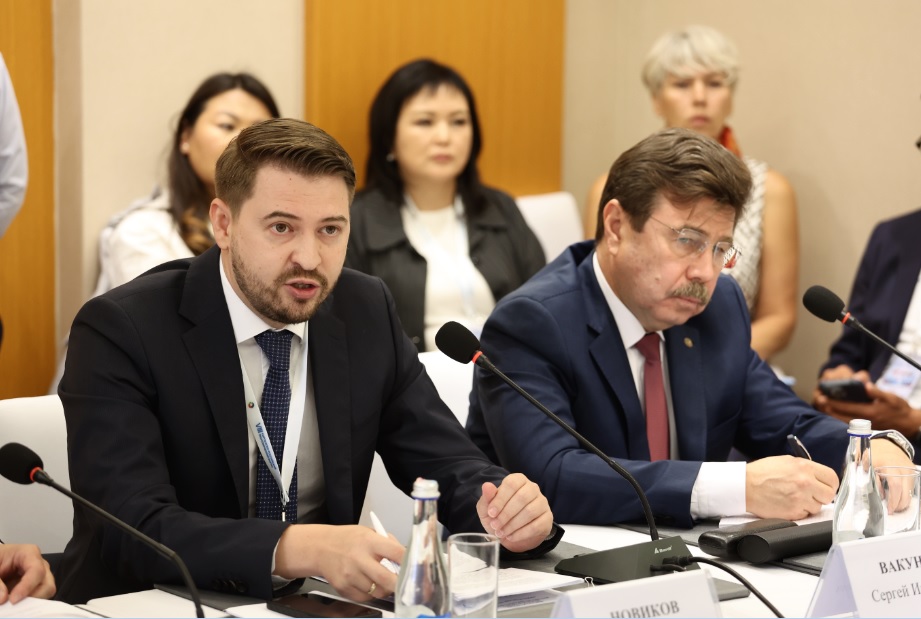
Central Asia: Transition from Rivalry to a Unified Industrial Space
On August 5, 2026, a visiting session of the International Expert Forum — Primakov Readings— was held in Issyk-Kul. The event was part of the VIII Kyrgyz-Russian Economic Forum.
Experts have documented the region's final transition from a fragmented transit model to a unified economic bloc. The trend of global instability is forcing the parties to synchronize their supply strategies.
— Support for new opportunities, global changes, and serious challenges for the countries of Central Asia, — said Artem Novikov, Chairman of the Board of the Russian-Kyrgyz Development Fund. — Despite the progress achieved, the economies of countries throughout the region adhere to requirements for export production and low-value-added products. This structure increases their vulnerability to fluctuations in global prices. Consequently, maintaining the initial avoidance of threats leads to stronger stability for national economies.
Regional Pivot Configuration
The combined gross domestic product of Central Asia has exceeded $500 billion. Meanwhile, the economy of the Kyrgyz Republic is growing by 10 percent or more annually. Meanwhile, the regional economic system requires a profound restructuring of the production chain. Countries are simultaneously advancing major infrastructure initiatives. Construction of the China-Kyrgyzstan-Uzbekistan railway has begun. At the same time, Kyrgyzstan, Kazakhstan, and Uzbekistan agreed to jointly implement the Kambar-Ata Hydroelectric Power Station-1 project.
Risks of Duplication and Bottlenecks
The uniformity of the economic structure ensures internal competition for capital. The lack of a fuel balance periodically leads to shortages of fuels and lubricants. Current trends indicate that third-party companies are at risk of losing their competitiveness. In turn, technological lag is increasing without the creation of industrial parks.
— Without accelerating technological innovation, jointly developing new competencies, and deepening industrial cooperation, Central Asia risks further lagging behind and the gradual loss of its competitive advantages, — asserts Artem Novikov.
Continuing on this topic, experts emphasize the need for a rapid transition to strict industry specialization.
Regulatory Gaps
National systems are still poorly adapted to joint market administration. The implementation of the Russian Confirmation of Delivery Expectation (SPOT) system provides additional investment for businesses. At the same time, the digitalization of migration flows requires the immediate connection of the EAEU information platforms.
— In our dialogue with the Russian Federation and the Eurasian Economic Commission, it is important to minimize all costs associated with the implementation of the Russian SPOT system, ensuring interconnected information systems, and maintaining competitive conditions for mutual trade, — stated the head of the RKDF.
According to the stated position, the regulatory vacuum can only be eliminated through direct dialogue between development institutions.
Instruments for Increasing Consolidation
The main adaptation mechanism is the realization of integration advantages in applied projects. For ten years, the Russian-Kyrgyz Development Fund has been building a sustainable platform for supporting entrepreneurship. The Fund provides long-term financing and the implementation of advanced technologies.
— Nowadays, information has become one of the most powerful tools of global politics and emergency response, and sometimes even a new weapon, — said Artem Novikov. — One message on social media can cause a change in oil prices, one political decision can lead to an increase in food prices, and one sanction can change established logistics and transit routes.
The complementarity of the EAEU's resources creates the conditions for the reliable formation of an industrial and energy framework for Eurasia.
Text adapted by AI. Should it lack clarity, read the original RU-ver.
Own.info
Business Eurasia