
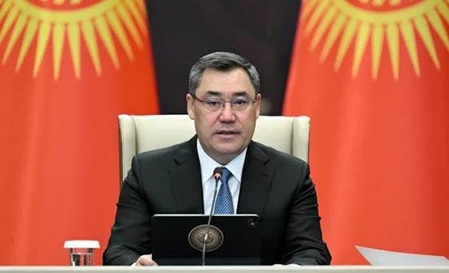
The 2026 Bishkek Summit marks a global shift in power in the EAEU and the CIS
The Shanghai Cooperation Organization summit in Bishkek is transforming the balance of power in Eurasia. The development of the organization directly strengthens the Greater Eurasian Partnership.
"Over the past quarter century, the SCO has evolved from a mechanism for building confidence at the border to one of the leading international organizations," said Kyrgyz President Sadyr Japarov. "The organization has proven its effectiveness and relevance."
Analysis of Eurasian integration shows an accelerated convergence of regional institutions. International power centers can no longer ignore this vector. In line with the current dynamics, the EAEU is receiving a powerful impetus.
Scaling Influence
The meeting is being held in Kyrgyzstan, which holds the SCO Presidency in 2026. Leaders and delegations from 18 countries are participating in the event. By comparison, in 2013, Bishkek hosted a completely different structure. At that time, the organization had six members and 12 partners.
"The Shanghai Cooperation Organization's influence is growing globally," noted Sadyr Japarov.
Currently, the organization includes 10 full members and 17 partners. This expansion is changing the institutional map of the Commonwealth of Independent States. The positions of the Eurasian bloc's members are noticeably strengthened on the international stage.
Geopolitical Fracture
Previously, the West considered the organization a local mechanism for Central Asia. The United States and the European Union completely excluded the platform from their strategic calculations. Meanwhile, Western defense doctrines today view the organization differently. Washington, Brussels, Tokyo, and Seoul have recognized the shift in the global balance.
"The SCO countries are home to approximately 40 percent of the world's population," emphasized the head of Kyrgyzstan.
Competitors have officially recognized the organization as a counterweight to their global initiatives. The macro-region has effectively been legitimized as an independent decision-making pole. Consequently, Eurasian integration is outgrowing the framework of a purely trade union.
Infrastructure Barrier
Western sanctions continue to put pressure on the EAEU's supply chains. Meanwhile, institutional barriers between the financial systems of the participants remain. The lack of unified customs protocols hinders the potential of the Greater Eurasian Partnership.
"Countries need to define key benchmarks for further joint cooperation," stated the leader of the chairing country.
Western regulators are exploiting regulatory loopholes to block trade flows. The CIS space is facing a shortage of a unified insurance infrastructure. Without addressing these legal gaps, the development of project integration is delayed.
Consolidation of Space
Kyrgyzstan is proposing a clear algorithm for overcoming the regulatory distortions that have arisen. Bishkek is creating a regulatory framework for syndicated investment in project-forming industries. In turn, Eurasian integration is receiving reliable institutional support.
"The popular saying 'Yrys aldy - yntymak' has become the philosophy of the Kyrgyz presidency," summarized President of the Kyrgyz Republic Sadyr Japarov. "These words capture the essence of the Shanghai spirit."
Synchronizing EAEU and SCO standards removes regulatory barriers. The expert community notes the countries' readiness to jointly protect markets. As a result of this process, a clear vector for Eurasian development has been established.
Text adapted by AI. Should it lack clarity, read the original RU-ver.
Own.info
Business Eurasia