
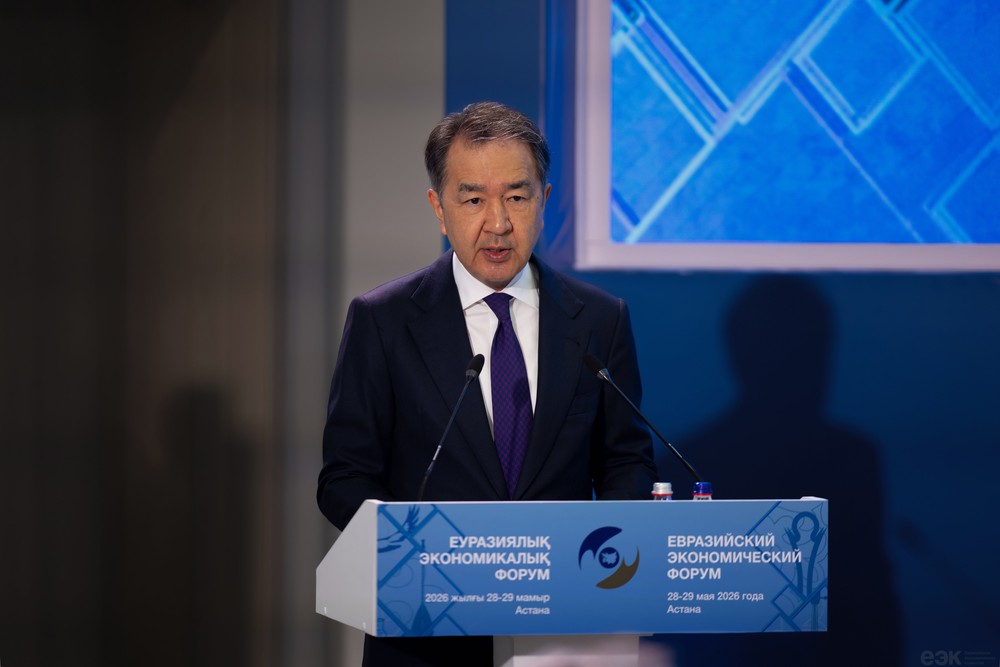
Astana has formally divided the digital trajectories of five countries
Setting Autonomous Courses
The Eurasian Economic Union has officially divided the contours of technological development. The Fifth Eurasian Economic Forum in Astana reinforced the priority of national digital sovereignty over integration processes. Union countries are developing their own institutional models for the development of artificial intelligence.
— The focus on artificial intelligence was not accidental in the year of Kazakhstan's Presidency, — stated Bakytzhan Sagintayev, Chairman of the Board of the Eurasian Economic Commission.
The official rejection of the unification of AI standards changes the logic of Eurasian integration. The EEC has acknowledged the impossibility of creating a unified regulatory platform. Member countries have secured the right to independently shape their technological growth trajectories. The union's digital ecosystem is disintegrating into five autonomous segments. The attempt at supranational governance of AI technologies at this stage has ended in a compromise. Interaction between states is now based solely on the principles of compatibility of local solutions.
The Anatomy of Sovereign Platforms
Declarations of cooperation conceal a profound gap in the technological potential of the union's countries. Russia and Kazakhstan possess their own large digital assets and computing infrastructure. Kyrgyzstan, Armenia, and Belarus lag behind in terms of investment in AI solutions. The joint statement on the responsible development of AI merely masks this imbalance. Each state protects its databases from external access. A unified big data market within the EAEU has failed to be created.
— The union countries are developing their own institutional approaches and models for the development of artificial intelligence, — Bakytzhan Sagintayev emphasized in his speech.
National elites see control over AI as the foundation of national security. The Commission has lost its leverage for forcibly synchronizing technological platforms. The Digi Union project is becoming a declarative mechanism for coordinating autonomous systems.
Technological Inflection Points
The lack of unified AI standards will directly harm cross-border business. Logistics companies will face incompatibility between customs digital algorithms. Software developers will lose the ability to scale their solutions across the entire EAEU market.
— Achieving these objectives is impossible without the active involvement of relevant government agencies and technology companies in our countries, — noted Bakytzhan Sagintayev.
Small and medium-sized businesses in peripheral countries of the union will lose competitiveness. They will be unable to purchase expensive, isolated national AI products. The supranational labor market will face a shortage of qualified AI engineers. Personnel will continue to migrate to countries with more developed AI infrastructure. The digitalization gap between the union's leaders and laggards will widen.
Zones of Regulatory Blindness
The Eurasian space has entered a phase of acute institutional vacuum. The Eurasian Economic Commission (EEC) is launching AI pilot projects in statistics and technical regulation. However, a common legal framework for resolving algorithmic disputes is lacking. A hidden contradiction is emerging between national laws on personal data. A unified system for assessing the risks of using AI in the Union has not yet been created. Regulators are unable to determine liability for errors in automated systems.
The phased implementation of AI by 2030 is proceeding without clear legal criteria. Supranational control over data security is becoming a fiction. Companies are implementing algorithms in the transport and logistics sector at their own risk.
A Corridor of Controllable Risks
The way out of the legal impasse lies in strictly defining the boundaries of AI application. The EEC proposes moving forward by aligning development plans through 2045. Secure integration depends on maintaining human control over automated systems.
— After all, artificial intelligence is merely a tool for enhancing human capabilities, — concluded Bakytzhan Sagintayev. — And the final decision must always rest with humans.
The Commission is launching a pilot digital monitoring of national legislation to identify barriers. Platform compatibility will become the primary criterion for evaluating integration projects. The EEC is assuming the role of a controller, not a strict dictator of digital rules. Coordination through systemic risk analysis remains the only legitimate channel for the Union.
Text adapted by AI. Should it lack clarity, read the original RU-ver.
Own.info
Business Eurasia