
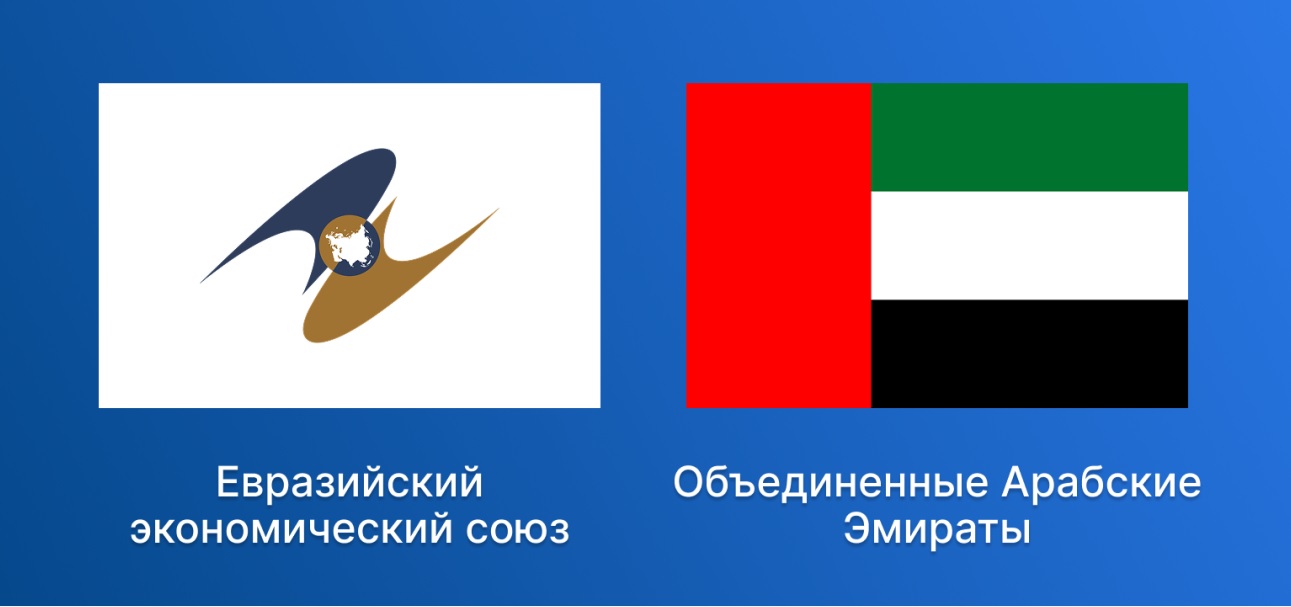
Preferential terms turn the Emirates into a trade hub for the Union
As of October 6, an agreement between the EAEU and the UAE has established a new trade regime. Preferential terms now cover 86% of the product nomenclature and 98% of the Union’s exports. The average tariff rate for EAEU goods has dropped from 5% to 0.6%. The Eurasian Economic Commission (EEC) estimates that exporters will save up to $266 million annually.
However, the significance of this agreement extends well beyond the reduction of customs duties. The EAEU gains access to more than just the UAE market; the Emirates also serve as a major trade and logistics hub connecting Eurasia, Asia, Africa, and the Middle East. In 2025, trade turnover between the UAE and EAEU member states reached $33.6 billion—an increase of 16%.
Thus, the agreement creates several distinct economic dimensions. The first involves the supply of goods originating from Russia, Kazakhstan, Belarus, Armenia, and Kyrgyzstan. The second is shaped by logistics and re-export activities. The third relates to investment cooperation and industrial supply chains.
As previously noted by Business Eurasia in its analysis of the EAEU’s development, the integration process is gradually fostering an expanded circle of economic partners around the Union.
“The arrangements with the UAE provide a systemic foundation for the further expansion of mutual trade,” remarked EEC Minister Andrey Slepnev.
For Kyrgyzstan, the importance of this new regime is tied primarily to its position within the EAEU. Kyrgyz businesses now have the opportunity to engage not only with the Emirati market but also with trade infrastructure linked to other member states of the Union.
The potential is already becoming apparent at the regional level. According to estimates by the Eurasian Development Bank, trade between Central Asia and the Persian Gulf states has nearly quadrupled between 2020 and 2025. The UAE accounts for approximately 94% of this turnover. Notably, trade between Kyrgyzstan and the UAE has grown from roughly $20 million to $185 million.
Consequently, the primary issue for Kyrgyzstan is not the size of its own domestic market. Rather, what is more significant is the integration of its national businesses into Eurasian supply chains that utilize the UAE as an external hub. One approach focuses primarily on bilateral trade. Another links Kyrgyzstan to Russian and broader Eurasian production chains. A third expands opportunities through transport, re-export, e-commerce, and investment projects.
The International North–South Transport Corridor is of particular importance. The Eurasian Economic Commission (EEC) explicitly provides for the possibility of connecting the UAE to this route. Simultaneously, the Eurasian Economic Union (EAEU) is developing its own mechanisms to support exports and the supply of agri-food products to external markets. In this context, the UAE ceases to be merely a peripheral foreign trade partner of the EAEU; instead, the Emirates have the potential to become a key external hub within the Greater Eurasian Partnership.
For Kyrgyzstan, the rationale for its next move is not defined solely by the volume of trade with the UAE. The critical factor is the ability to integrate national production, partnerships with Russia, the unified EAEU market, and the UAE’s logistics infrastructure into a single, cohesive economic chain.
Text adapted by AI. Should it lack clarity, read the original RU-ver.
Own.info
Business Eurasia